
Estimated reading time: 6 minutes
- What Are Tumor Suppressor Genes? The Definition
- The “Two-Hit Hypothesis”: Why Two Mistakes Are Needed
- Key Examples of Tumor Suppressor Genes
- p53: The Guardian of the Genome
- RB1: The First Tumor Suppressor
- Other Notable Examples
- Conclusion: A Delicate Balance Tipped
In the previous lesson, we explored oncogenes—the mutated “gas pedals” that propel a cell toward uncontrolled division. But a car with a stuck accelerator isn’t doomed if its brakes are fully functional. In the complex vehicle of a cell, the crucial counterbalance to oncogenes is a class of genes known as tumor suppressor genes.
These genes are the guardians of cellular order, the “brakes” that halt the cell cycle when damage is detected, and the repair crew that fixes DNA. When these genes fail, the path to cancer becomes wide open. This lesson will define tumor suppressor genes, explain the foundational “two-hit hypothesis” that governs their behavior, and highlight key examples like p53 and RB1, whose discovery revolutionized our understanding of cancer genetics.
What Are Tumor Suppressor Genes? The Definition
Tumor suppressor genes are segments of DNA that code for proteins responsible for controlling cell growth, repairing DNA mistakes, and initiating programmed cell death (apoptosis) when damage is irreparable. They act as critical safeguards against cancer.
If an oncogene is a stuck gas pedal, a tumor suppressor gene is a functional brake system. When working correctly, they:
-
Slow or stop cell division.
-
Command damaged cells to die (apoptosis).
The fundamental difference from oncogenes is that tumor suppressor genes prevent cancer. Cancer occurs when these genes are inactivated or lost. Because a cell has two copies (alleles) of each gene—one from each parent—both copies must typically be damaged for the “brakes” to fail completely. This leads us to a cornerstone concept in cancer genetics.
The “Two-Hit Hypothesis”: Why Two Mistakes Are Needed
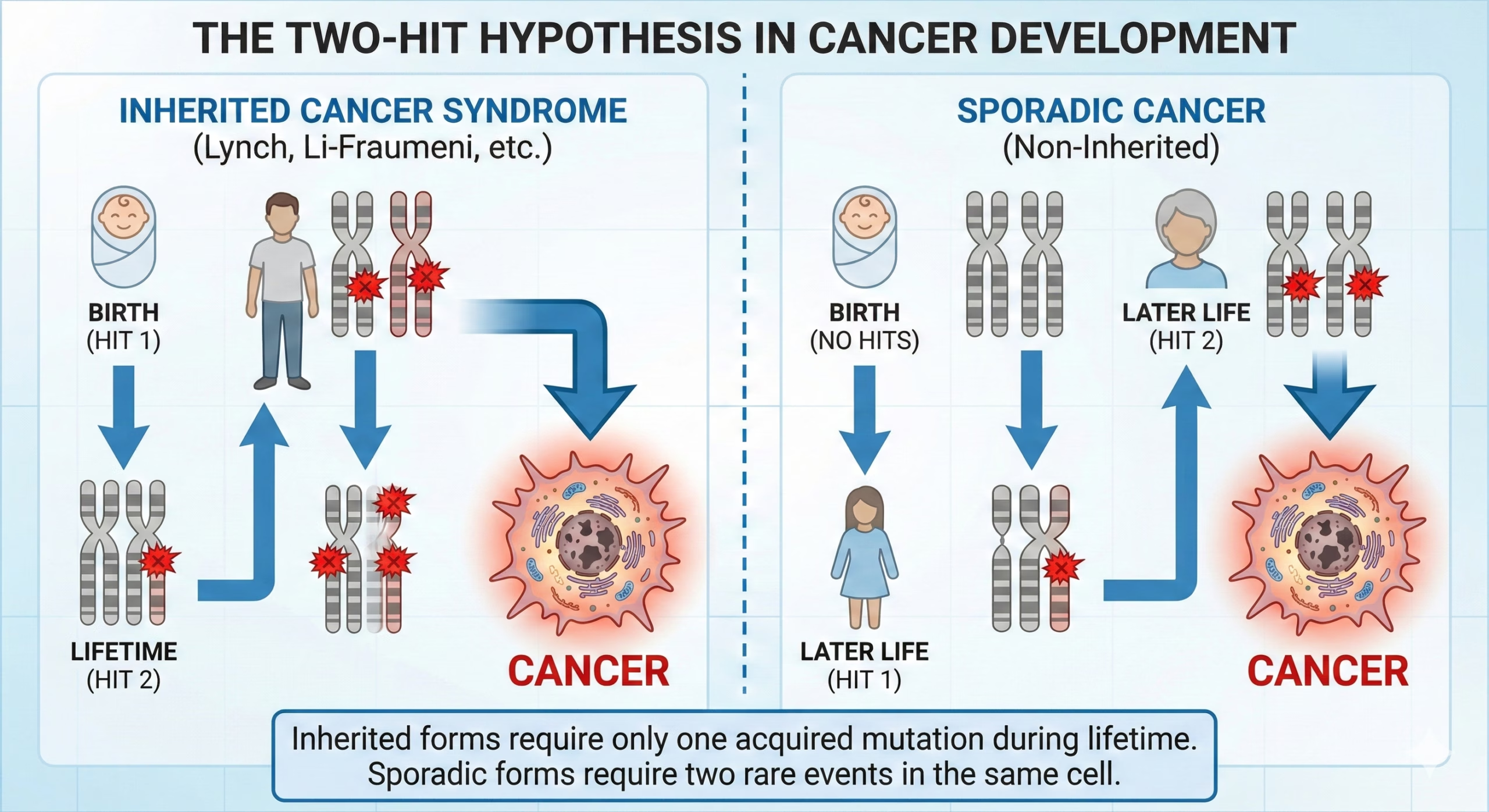
Proposed by Alfred Knudson in 1971, the “two-hit hypothesis” (or Knudson hypothesis) explains why some cancers can be inherited and others appear sporadically. Knudson was studying retinoblastoma, a rare childhood eye cancer, and his model has since been applied to many inherited cancer syndromes.
The hypothesis states that both copies of a tumor suppressor gene must be “hit” by mutations for cancer to develop.
-
Inherited (Familial) Cancer:
-
Hit 1 (Germline): A person is born with one defective copy of the gene in every cell of their body. This mutation is inherited from a parent.
-
Hit 2 (Somatic): During a person’s lifetime, a single random mutation occurs in the one remaining functional copy of the gene in a specific cell. With both brakes broken, that cell can become cancerous.
-
Result: These individuals have a much higher risk of developing cancer, often at a younger age and in multiple sites.
-
-
Sporadic (Non-Inherited) Cancer:
-
Hit 1 (Somatic): A person is born with two normal copies of the gene. A random mutation inactivates one copy in a single cell.
-
Hit 2 (Somatic): Later, another random mutation inactivates the second copy in that same cell.
-
Result: This requires two unlikely events in the same cell, making sporadic cancer less common in specific tissues and typically occurring later in life.
-
This two-step process explains why we don’t all get cancer from a single mutation and why individuals with inherited mutations are at such high risk.
Key Examples of Tumor Suppressor Genes
Understanding specific examples brings the critical role of these genes into sharp focus.
p53: The Guardian of the Genome
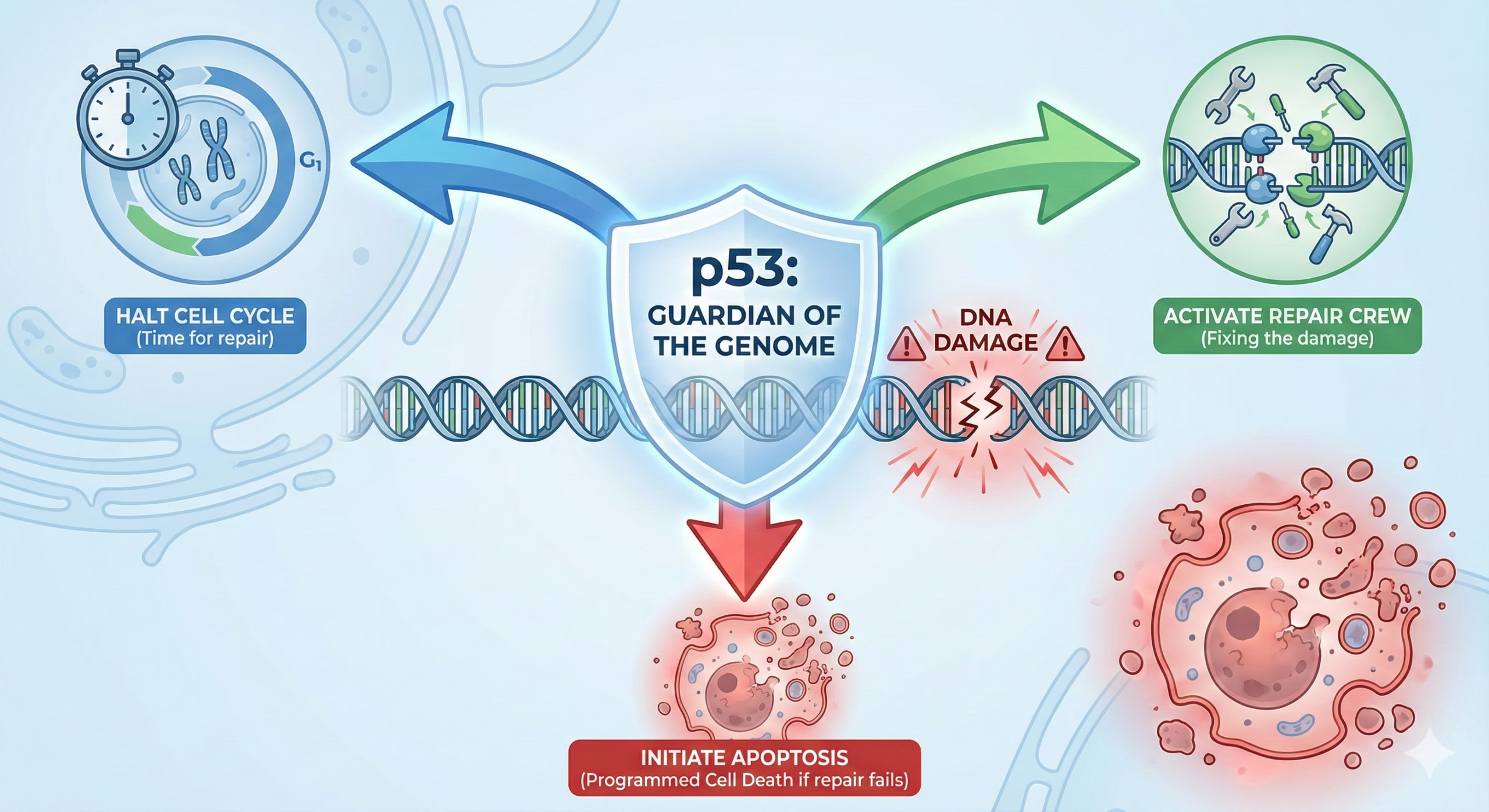
Often called “the guardian of the genome,” p53 is arguably the most important tumor suppressor gene and is mutated in over 50% of all human cancers.
-
Normal Function: The p53 protein is a transcription factor that is activated in response to cellular stress, particularly DNA damage. Its job is to:
-
Halt the Cell Cycle: It pauses division at the G1/S checkpoint (from [Lesson 1.2]) to allow time for DNA repair.
-
Activate DNA Repair Proteins: If the damage is fixable, p53 calls in the repair crew.
-
Initiate Apoptosis: If the DNA damage is too severe, p53 triggers the cell to self-destruct, preventing it from passing on mutations.
-
-
Consequence of Inactivation: When p53 is mutated, damaged cells are not stopped. They continue to divide, accumulating even more genetic errors. This genomic instability is a breeding ground for cancer. Li-Fraumeni syndrome, a rare inherited disorder caused by a germline p53 mutation, dramatically increases a person’s risk for multiple cancers.
RB1: The First Tumor Suppressor
The RB1 (Retinoblastoma) gene was the first tumor suppressor gene to be cloned, and its study gave rise to the two-hit hypothesis.
-
Normal Function: The RB1 protein is a master regulator of the cell cycle, primarily controlling the transition from the G1 phase to the S phase (where DNA is replicated). In its active, unphosphorylated state, RB1 binds to and inhibits transcription factors like E2F, which are required to turn on genes for DNA synthesis. It acts as a “gatekeeper,” physically blocking the cell from entering S phase until the appropriate growth signals are received.
-
Consequence of Inactivation: When both copies of RB1 are inactivated, the RB1 protein is absent or non-functional. The E2F transcription factors are permanently free, driving the cell relentlessly into the DNA synthesis phase regardless of signals. This leads to the uncontrolled division characteristic of retinoblastoma. RB1 pathway inactivation is also found in many other cancers, including osteosarcomas and small cell lung cancer.
Other Notable Examples
-
BRCA1 and BRCA2: These genes code for proteins involved in the accurate repair of DNA double-strand breaks. Inherited mutations in these genes significantly increase the risk of hereditary breast and ovarian cancer, as well as other cancers. This is why [Genetic Testing for Hereditary Cancer Risk] can be a powerful tool for prevention.
-
APC: A gatekeeper gene in the colon. Its inactivation is the initiating event in most colorectal cancers, leading to the uncontrolled growth of colon polyps that can become malignant.
Conclusion: A Delicate Balance Tipped
The story of cancer is a story of balance. On one side, oncogenes provide the growth signals. On the other, tumor suppressor genes provide the restraint. For a cell to become cancerous, this balance must be tipped decisively toward growth. This requires both the activation of oncogenes (stepping on the gas) and the inactivation of tumor suppressor genes (cutting the brakes).
Understanding the two-hit hypothesis and the critical roles of genes like p53 and RB1 provides a complete picture of the genetic seesaw at the heart of cancer. It explains patterns of inheritance, the multi-step nature of cancer development, and highlights why protecting the integrity of our genome is so vital.
Suggested External Links for Authoritative Information:

Waqas Khan is a dedicated writer and blogger who has been crafting compelling content since 2012. Specializing in science and technology topics, he has built a reputation for translating complex technical concepts into reader-friendly articles. His work demonstrates a deep understanding of emerging technologies and scientific advancements, making him a reliable voice in the digital content space.

