
Estimated reading time: 7 minutes
- The Epigenetic Layer: Writing the Instructions for Gene Expression
- The microRNA Layer: Fine-Tuning the Message
- The Dance: How Epigenetics and miRNAs Interact
- When the Dance Becomes Dysregulated: The Cancer Connection
- A New Therapeutic Frontier: Targeting the Regulatory Network
- Conclusion: Cancer as a Disease of Regulatory Networks
- Key Takeaways
- References
For decades, the search for cancer’s secrets focused almost exclusively on the genetic code. We sequenced genes, hunted for mutations, and built targeted therapies around specific DNA errors. And we had good reason—genetic mutations are undeniably central to cancer.
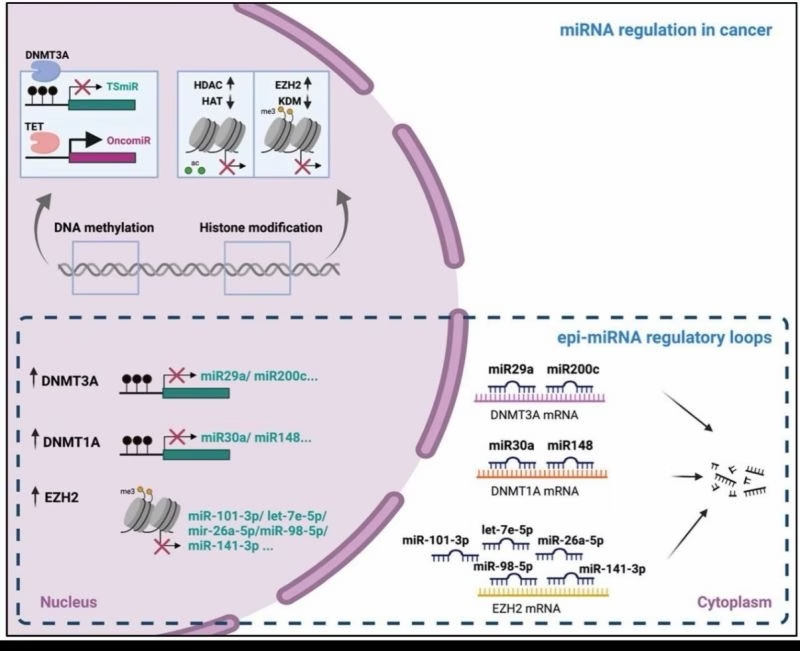
But the figure accompanying this article illustrates a deeper, more complex truth. Gene expression in cancer is not driven solely by genetic mutations. It is shaped by a sophisticated, multi-layered regulatory network where epigenetics and microRNAs (miRNAs) continuously interact to modulate cellular behavior.
This is the world of regulatory chaos—where the instructions written in our DNA can be amplified, silenced, or twisted without changing a single letter of the genetic code.
The Epigenetic Layer: Writing the Instructions for Gene Expression
If DNA is the hardware, epigenetics is the software that tells it what to do. Epigenetic modifications don’t change the DNA sequence itself; they change how cells read the genes. The two most well-studied epigenetic mechanisms are:
-
DNA Methylation: Performed by enzymes called DNA methyltransferases (like DNMT3A and DNMT1), this process adds chemical tags (methyl groups) to DNA, typically silencing the associated gene.
-
Histone Modification: Enzymes like EZH2 (part of the PRC2 complex) add or remove tags on histone proteins—the spools around which DNA is wound. These modifications can either compact the DNA (silencing genes) or open it up (activating genes).
In normal cells, these epigenetic marks are carefully regulated, ensuring that the right genes are active in the right cells at the right times.
The microRNA Layer: Fine-Tuning the Message
MicroRNAs are small, non-coding RNA molecules that act as master regulators of gene expression. They work by binding to messenger RNAs (mRNAs)—the blueprints for making proteins—and targeting them for destruction or blocking their translation.
A single miRNA can regulate hundreds of different genes, making them powerful orchestrators of cellular behavior. They are involved in virtually every biological process, from development to immunity to cell death. Recent research has shown that non-coding RNAs, including miRNAs, are now universally recognized as pivotal players in cell regulatory networks across a broad spectrum of biological processes. Owing to their critical regulatory roles, miRNA dysfunction is closely associated with the etiopathogenesis of various human malignancies, including cancer.
The Dance: How Epigenetics and miRNAs Interact
The real magic—and the source of the figure’s complexity—lies in how these two layers talk to each other. They don’t operate in isolation. Instead, they form intricate regulatory feedback loops.
Epigenetics Silences miRNAs:
Just as epigenetic machinery can silence protein-coding genes, it can also silence the genes that produce microRNAs. Enzymes like DNMT3A, DNMT1, and EZH2 can add methyl groups or repressive histone marks to the promoters of miRNA genes, effectively turning them off. This is one way that cancer cells can shut down tumor-suppressive miRNAs.
miRNAs Regulate Epigenetic Enzymes:
Here’s where it gets really interesting. A specific class of microRNAs, sometimes called “epi-miRNAs,” can directly target and regulate the expression of epigenetic enzymes themselves. The figure highlights several key examples:
-
miR-29 family members can target and downregulate DNMT3A and DNMT1, reducing DNA methylation. Recent research on thyroid cancer demonstrated that a circular RNA (hsa_circ_0023990) could modulate NIS promoter methylation via the miR-448/DNMT1 signaling pathway, showing how miRNAs directly regulate DNA methyltransferase expression.
-
miR-101 targets EZH2, reducing repressive histone marks. Studies in glioblastoma have shown that miR-217-5p acts as an EZH2 regulator, and its reconstitution can re-activate PRC2-repressed genes and inhibit tumor growth.
This creates a beautiful, self-regulating circuit: epigenetic enzymes control miRNA expression, and miRNAs control epigenetic enzyme expression. It’s a biological feedback loop that maintains cellular balance.
When the Dance Becomes Dysregulated: The Cancer Connection
In cancer, these elegant feedback loops frequently break down. The result is a cascade of epigenetic alterations that can:
-
Promote Oncogenic Signaling: By silencing tumor-suppressive miRNAs, cancer cells can remove critical brakes on growth pathways.
-
Suppress Tumor-Inhibitory Pathways: Aberrant epigenetic marks can silence genes that would normally prevent invasion or metastasis.
-
Reshape the Transcriptional Landscape: The entire program of gene expression in the cell can be hijacked, creating a new, malignant identity.
For example, if EZH2 is overactive (a common finding in many cancers), it can silence miRNAs that would normally inhibit its own expression. Research in anaplastic thyroid cancer has demonstrated that EZH2 inhibition suppresses EMT programs by downregulating canonical Wnt signaling genes and leads to significant upregulation of tumor suppressor miRNAs, notably the miR-200 family.
Multi-omics studies in lower grade glioma have revealed that miRNA dysregulation is associated with alterations in DNA methylation and copy number variation. Researchers identified four subtypes with differing prognoses based on integrative analysis of these epigenetic mechanisms, and found candidate miRNAs associated with immune evasion and response to immunotherapy.
A New Therapeutic Frontier: Targeting the Regulatory Network
From a clinical oncology perspective, this biology opens an exciting frontier. The epigenetic-miRNA axis represents a new layer of therapeutic opportunity.
Instead of targeting a single mutant protein, we might be able to restore normal gene regulation by intervening in these regulatory networks. Strategies being explored include:
-
DNA Methyltransferase Inhibitors: Drugs that reverse aberrant DNA methylation, potentially reactivating silenced tumor-suppressive miRNAs and genes.
-
EZH2 Inhibitors: Agents that block the activity of this key epigenetic enzyme. Research has shown that EZH2 inhibition can suppress cancer cell dedifferentiation, growth, migration, and invasion by downregulating EMT markers.
-
miRNA Mimics or Antagonists: Synthetic miRNAs designed to restore the function of tumor-suppressive miRNAs. In glioblastoma models, nanoparticle formulations delivering miR-217-5p have been shown to inhibit EZH2, re-activate PRC2-repressed genes, impair tumor growth, and enhance the effects of ionizing radiation.
-
Combination Strategies: Perhaps most powerfully, these agents could be combined with existing immunotherapies or targeted therapies to enhance their effectiveness and overcome resistance.
Conclusion: Cancer as a Disease of Regulatory Networks
Ultimately, understanding these epi-miRNA regulatory circuits reminds us of a profound truth: cancer is not only a genetic disease—it is also a disease of regulatory networks. The epigenetic plasticity of cancer cells plays a central role in tumor evolution, allowing them to adapt to stress, evade therapy, and metastasize.
The figure we’ve explored is more than a diagram of molecular interactions. It is a map of cancer’s control systems. And as we learn to read this map, we also learn where to strike.
By targeting the enzymes that write epigenetic marks and the microRNAs that fine-tune gene expression, we may be able to restore order to the regulatory chaos of cancer. This is the promise of molecular oncology: not just treating the tumor, but reprogramming it.
Key Takeaways
-
Epigenetics (DNA methylation, histone modifications) controls gene expression without changing the DNA sequence.
-
MicroRNAs are master regulators that can silence hundreds of genes simultaneously and their dysfunction is closely linked to cancer.
-
Feedback loops exist where epigenetic enzymes control miRNA expression, and miRNAs control epigenetic enzyme expression.
-
In cancer, these loops become dysregulated, driving oncogenic signaling and therapeutic resistance.
-
Therapeutic strategies targeting this axis include DNMT inhibitors, EZH2 inhibitors, and miRNA-based therapies.
-
Combination approaches targeting both genetic and epigenetic vulnerabilities represent a promising future direction.
References
-
Costa S, et al. Epigenetic Regulation of Chromatin Functions by MicroRNAs and Long Noncoding RNAs and Implications in Human Diseases. Biomedicines. 2025;13(3):725. https://pubmed.ncbi.nlm.nih.gov/40149701/
-
Abid F, et al. Genetic Variants at PRKCG Splice and UTR Sites Promote Cancer Susceptibility by Disrupting Epigenetic and miRNA Regulatory Network. J Cancer. 2024;15(20):6644-6657. https://jcancer.org/v15p6644.htm
- de Mello DC, et al. Effect of EZH2 inhibition in anaplastic thyroid cancer epithelial-mesenchymal transition revealed by transcriptome analysis. Cancer Res. 2025;85(8_Suppl_1):Abstract nr 5135. https://www.scilit.com/publications/33fca1d51866474336c88bb93ea15daf
-
Yang Z, et al. Integrative analysis of genomic and epigenomic regulation reveals miRNA mediated tumor heterogeneity and immune evasion in lower grade glioma. Commun Biol. 2024;7(1):824. https://accounts.public.ce.basespace.illumina.com/b/search/article.nb?id=38971948

We are an experienced tutors service platform who believes expert help should be affordable. We specialize in helping students overcome challenges and build confidence in a supportive, one-on-one environment. Our goal is to make learning accessible and effective for every student.
Related Posts
- Plasmid DNA Miniprep Extraction Protocol (GeneJET Spin Column Method)
- PCR Reaction Setup, Master Mix Calculation, and Annealing Optimization Protocol
- Lyophilized Primer Rehydration and Working Dilution Calculations Protocol
- SDS-PAGE Gel Preparation and Buffer Formulation Protocol
- First-Strand cDNA Synthesis Protocol (RevertAid Reverse Transcriptase SOP)

