
Estimated reading time: 5 minutes
- The 7 Major Warning Signs of Cancer: The “CAUTION” Mnemonic
- The Top 3 Early Warning Signals
- How Your Body Warns You: A Broader List of 20 Potential Signs
- What is the “2-Week Rule” for Suspected Cancer?
- Conclusion: Listen to Your Body and Act
- References & Authoritative Resources
When it comes to cancer, knowledge is more than power—it can be a lifesaver. Understanding the warning signs your body sends is the first critical step toward early detection, which dramatically improves treatment outcomes.
This guide consolidates the most common questions into one comprehensive resource. We’ll break down the classic “7 symptoms,” identify the top three early warnings, explore a broader list of signs, and explain a crucial medical pathway known as the “2-week rule.”
The 7 Major Warning Signs of Cancer: The “CAUTION” Mnemonic
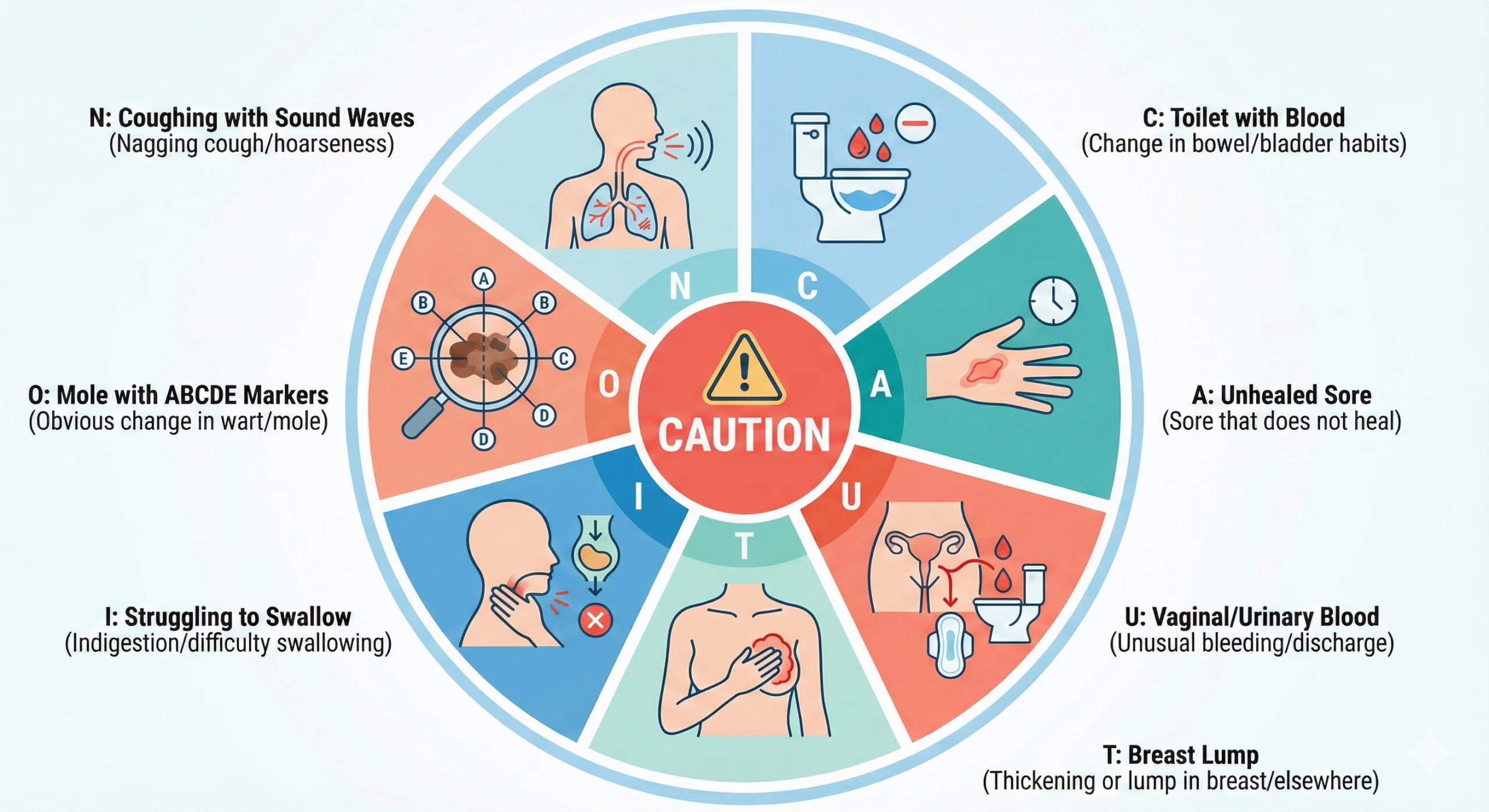
One of the easiest ways to remember the most common cancer symptoms is with the acronym CAUTION 1, 5. These are the seven major red flags that warrant a conversation with your doctor.
-
C – Change in bowel or bladder habits: This includes new, persistent constipation or diarrhea, blood in your stool or urine, or a noticeable change in frequency or urgency.
-
A – A sore that does not heal: Any sore on your skin, inside your mouth, or on a genital area that doesn’t heal within a few weeks should be evaluated.
-
U – Unusual bleeding or discharge: This includes coughing up blood, unexpected vaginal bleeding (especially after menopause), blood in the urine, or bloody discharge from the nipple.
-
T – Thickening or lump in the breast or elsewhere: A new lump or a lump that has changed in size is one of the most well-known signs. Don’t limit this to just breasts; check your testicles, armpits, neck, and groin.
-
I – Indigestion or difficulty swallowing: Persistent heartburn or a feeling that food is getting “stuck” in your throat can be a sign of cancers in the esophagus, throat, or stomach.
-
O – Obvious change in a wart or mole: Remember the ABCDEs of melanoma: Asymmetry, irregular Borders, changes in Color, a Diameter larger than a pencil eraser, and Evolving over time.
-
N – Nagging cough or hoarseness: A cough that lasts for more than three weeks, a hoarse voice that doesn’t resolve, or coughing up blood are key symptoms for lung and throat cancers.
The Top 3 Early Warning Signals
While all the CAUTION signs are important, three symptoms are particularly significant because they are common across many cancer types and can appear early 12, 9:
-
Unexplained Weight Loss: Losing 10 pounds or more without trying can be one of the first signs of cancer, particularly cancers of the pancreas, stomach, esophagus, or lung.
-
Persistent, Unexplained Fatigue: This isn’t just ordinary tiredness. It’s a deep exhaustion that doesn’t get better with rest and can interfere with your daily life, often caused by the cancer using your body’s energy.
-
A New, Persistent Lump or Swelling: This remains one of the most tangible and common first signs, whether it’s in the breast, a lymph node, or another part of the body.

How Your Body Warns You: A Broader List of 20 Potential Signs
Cancer can cause a wide range of local and systemic (whole-body) symptoms. Beyond the “CAUTION” seven, here is a more comprehensive list of 20 ways your body might signal that something is wrong 9, 11, 12:
-
Persistent, unexplained pain in any area of the body.
-
A nagging cough or hoarseness.
-
Changes in bowel habits (constipation, diarrhea).
-
Blood in the stool or black, tarry stools.
-
Blood in the urine.
-
Unexplained weight loss.
-
Persistent indigestion or discomfort after eating.
-
Difficulty swallowing (dysphagia).
-
A sore that does not heal.
-
Unusual bleeding or discharge.
-
A noticeable lump or thickening.
-
A obvious change in a wart or mole.
-
Skin changes, such as yellowing (jaundice), darkening, or redness.
-
Persistent bloating or abdominal pain.
-
Changes in bladder habits or pain when urinating.
-
Persistent, unexplained fever or night sweats.
-
Frequent or recurrent infections.
-
Persistent headaches.
-
Vision or hearing changes.
-
Neurological symptoms like seizures, dizziness, or confusion.

Important Note: This list is comprehensive, but it is not exhaustive. Having one or more of these symptoms does not mean you have cancer. Many are caused by benign conditions. However, if they are new, persistent, or unexplained, they deserve medical attention.
What is the “2-Week Rule” for Suspected Cancer?
In healthcare systems like the UK’s NHS, the “2-week wait” (2WW) pathway is a crucial protocol designed to speed up diagnosis 2, 3, 4.
-
What it is: A guideline for General Practitioners (GPs) that states if a patient’s symptoms fit specific criteria that could indicate cancer, the GP must make an urgent referral to a specialist.
-
The Goal: The patient must be seen by a hospital specialist within two weeks of the referral to minimize delays in diagnosis and treatment.
-
What it means for you: If your doctor is concerned about your symptoms and mentions the “2-week rule,” it means they are taking your symptoms seriously and fast-tracking you for further investigation. It does not mean you definitely have cancer, but it ensures you get answers quickly.

Conclusion: Listen to Your Body and Act
Your body has an incredible way of signaling when something is out of balance. The most important takeaway is to pay attention to changes that are persistent, unexplained, or new for you.
Don’t let fear prevent you from seeking help. While these symptoms can be alarming, remember that most turn out to have a non-cancerous cause. But the only way to know for sure is to see a doctor. Early action is your best defense.
References & Authoritative Resources

Waqas Khan is a dedicated writer and blogger who has been crafting compelling content since 2012. Specializing in science and technology topics, he has built a reputation for translating complex technical concepts into reader-friendly articles. His work demonstrates a deep understanding of emerging technologies and scientific advancements, making him a reliable voice in the digital content space.

