
Estimated reading time: 7 minutes
- What Is Mental Burnout, Really?
- The Full Spectrum of Burnout Signs: Are You at Risk?
- The Critical Difference: Burnout vs. Depression
- Who’s Most at Risk? Beyond the “Busy Professional”
- What to Do Next: An Evidence-Based Recovery Plan
- When It’s Time to Seek Professional Help
- Frequently Asked Questions
- Conclusion: Your Well-being is Non-Negotiable
- Immediate Resources & Further Reading
We’ve all felt stressed, but what happens when that stress becomes a constant, heavy weight that dims your passion and drains your battery with no sign of recharging? That’s burnout. In our always-on, high-pressure culture, burnout has become a silent epidemic. But unlike a bad week, burnout won’t be solved by a single good night’s sleep. This guide will help you spot the subtle signs and provide a modern, research-backed path to recovery.
Read also: 10 Tips to Fall Back Asleep After Waking Up at Night
Read also: 12 Healthy Sleep Hygiene Tips for a Restful Night and Energized Morning
Read also: How to Fall Asleep in 10, 60, or 120 Seconds
What Is Mental Burnout, Really?
Burnout isn’t a medical diagnosis but a legitimate psychological syndrome resulting from chronic workplace stress that has not been successfully managed. According to leading mental health authorities, it’s characterized by three key dimensions 1:
-
Feelings of energy depletion or exhaustion
-
Increased mental distance from one’s job, or feelings of negativism or cynicism related to one’s work
-
Reduced professional efficacy
In short, it’s what happens when your body and mind say, “I cannot do this anymore.”
The Full Spectrum of Burnout Signs: Are You at Risk?
Most lists cover the basics, but burnout seeps into every part of your life. Here’s a comprehensive checklist.
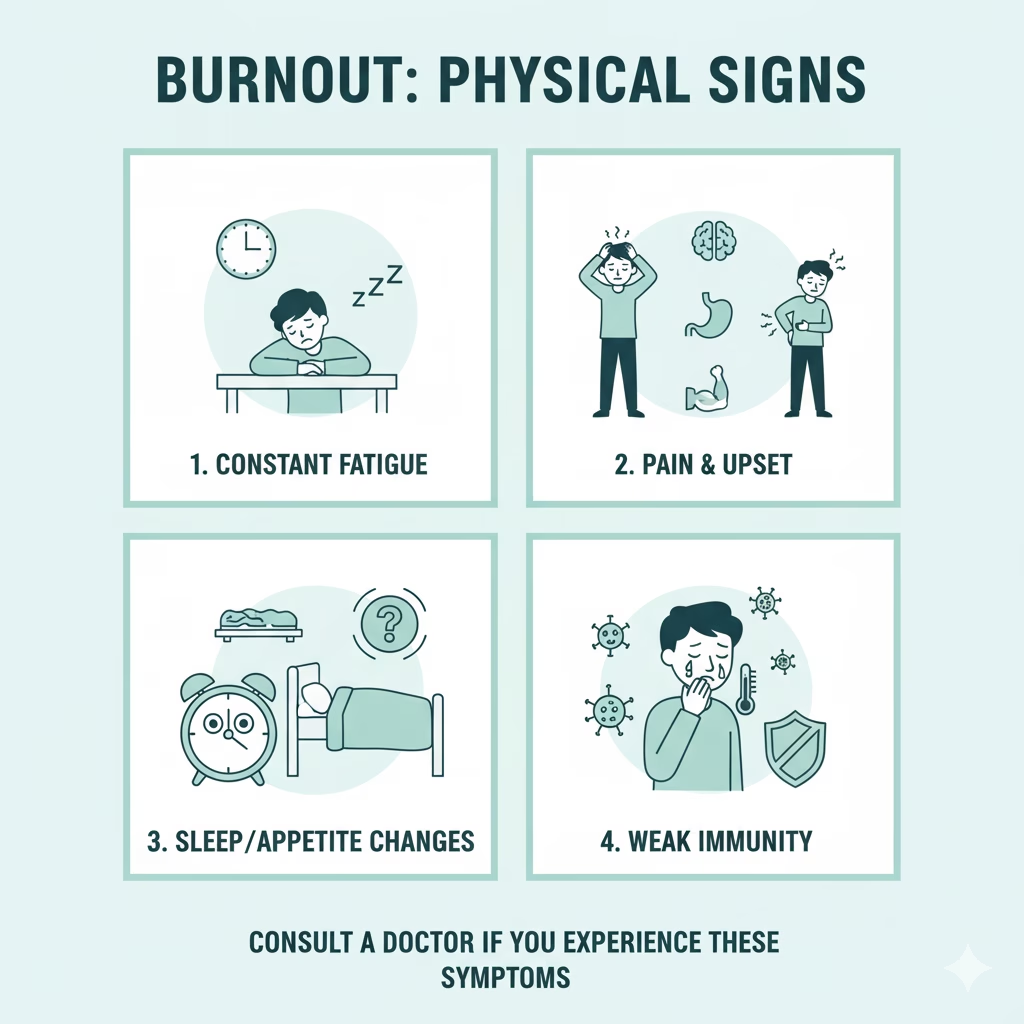
Physical Signs:
-
Constant fatigue and low energy, even after rest.
-
Frequent headaches, muscle pain, or stomach issues.
-
Changes in appetite or sleep patterns (insomnia or sleeping too much).
-
Weakened immune system, getting sick more often.
Emotional Signs:
-
Cynicism and Detachment: Feeling numb or negative about your job, colleagues, and life.
-
Irritability and Impatience: Snapping at loved ones or colleagues over minor things.
-
Sense of Failure and Self-Doubt: Feeling nothing you do is good enough.
-
Loss of Motivation: The passion and drive you once had have evaporated.
-
Feeling Trapped or Helpless.

Behavioral Signs:
-
Declining Performance: Procrastination, missed deadlines, trouble concentrating.
-
Withdrawal: From social activities, family, and friends.
-
Using Food, Drugs, or Alcohol to cope.
-
Neglecting Responsibilities at work and home.

The Critical Difference: Burnout vs. Depression
This is a crucial distinction most blogs gloss over. While they can co-exist and share symptoms like exhaustion and loss of interest, they are different 1:
-
Burnout is typically tied to a specific domain (like work or caregiving) and can improve with rest and changes to that environment.
-
Depression is pervasive, affecting all areas of life, and is a clinical mental health condition that often requires professional treatment.
If your low mood and lack of interest are present in all aspects of your life, not just work, it’s vital to speak to a doctor or therapist to explore a potential depression diagnosis.
Read Also: Why Can’t I Fall Asleep? Common Reasons and Solutions
Read Also: 5 Easy Tips to Improve Your Sleep Tonight
Who’s Most at Risk? Beyond the “Busy Professional”
While anyone can experience burnout, certain groups face a higher risk, a nuance often missing from generic advice.
-
Neurodivergent Individuals (ADHD, Autism): The constant effort to “mask” or cope in a neurotypical world is profoundly exhausting, leading to a specific type of “autistic burnout” or “ADHD burnout” characterized by severe skill regression and sensory overload, requiring longer, more tailored recovery 1.
-
Caregivers: Those caring for children, aging parents, or sick relatives.
-
High-Demand Professionals: Healthcare workers, teachers, and service industry employees.
-
Perfectionists and High-Achievers: The relentless self-imposed pressure is a fast track to burnout.
Read also: Living with Anxiety? Here Are 13 Effective Coping Strategies
What to Do Next: An Evidence-Based Recovery Plan
Recovery isn’t about one magic solution; it’s a multi-faceted process.
Step 1: Acknowledge and Validate
The first step is to name it. Say to yourself, “I am experiencing burnout.” This isn’t a sign of weakness; it’s a sign that you’ve been strong for too long.
Step 2: Prioritize Rest, Not Just Sleep
Rest is more than sleep. It’s:
-
Micro-Breaks: New research highlights the power of 5-10 minute breaks every hour during work to walk, stretch, or stare out the window. This reduces stress accumulation more effectively than one long break at the end of the day 2.
-
Digital Detox: Set strict boundaries on work emails and doomscrolling. The constant influx of information is a major drain.
-
True Time Off: A weekend where you truly disconnect and do nothing “productive.”
Step 3: Set Unapologetic Boundaries (With Scripts)
Most blogs say “set boundaries” but don’t show you how. Here are examples:
-
To manage workload: “I understand this is a priority. Given my current projects A and B, which one would you like me to deprioritize to take this on?”
-
For after-hours communication: “I’ve set an ‘offline’ notification on my phone after 6 PM to recharge. I will respond to this first thing in the morning.”
-
To protect your time: “I can’t commit to that right now, but thank you for thinking of me.”
Step 4: Reconnect with Your Body and Joy
-
Movement: Not as punishment, but as release. A gentle walk, dancing in your kitchen, or stretching.
-
Nourishment: Focus on regular, balanced meals to stabilize your energy.
-
Active Hobbies: Engage in activities that are actively relaxing and fulfilling, like gardening, painting, or playing music, which have been shown to be more restorative than passive consumption like binge-watching 2.
Step 5: Seek Connection
Isolation fuels burnout. Reach out to trusted friends, family, or a support group. Sometimes, just saying “I’m struggling” out loud can be a massive relief.

When It’s Time to Seek Professional Help
You would see a doctor for a persistent physical illness. Your mental health deserves the same care. Seek help if you:
-
Feel hopeless or have thoughts of self-harm.
-
Cannot function in your daily responsibilities.
-
Your symptoms don’t improve after several weeks of actively trying to rest and implement changes.
-
Suspect you may be dealing with depression or an anxiety disorder.
Therapy can provide powerful tools (like CBT) to reframe thoughts and develop coping strategies.
Frequently Asked Questions
Q: How long does it take to recover from burnout?
A: There’s no set timeline. It can take weeks, months, or even years. Recovery is a journey, not a destination. Be patient and kind to yourself.
Q: What if my workplace is the main cause and I can’t just leave?
A: Focus on what you can control: your boundaries, your after-work time, and your internal narrative. Use your paid time off. If possible, advocate for change with HR or a manager. Ultimately, if the environment is toxic, planning a long-term exit strategy can be a powerful source of hope.
Q: Can you fully recover?
A: Yes, but “recovered” might not mean going back to exactly who you were before. It often means integrating new wisdom about your limits and building a life that is more sustainable and aligned with your values.
Conclusion: Your Well-being is Non-Negotiable
Burnout is a clear signal that your current way of living is not sustainable. Listening to this signal is not a failure—it’s a profound act of self-preservation. By acknowledging the signs, giving yourself permission to rest, and taking small, consistent steps toward recovery, you can find your way back to a life filled with energy and purpose.
Immediate Resources & Further Reading
-
Crisis Text Line: Text HOME to 741741
-
National Suicide Prevention Lifeline: 988
-
Mental Health America Screening Tools: mhascreening.org
-
Mental Health America: Burnout Signs, Causes, and How to Recover

Waqas Khan is a dedicated writer and blogger who has been crafting compelling content since 2012. Specializing in science and technology topics, he has built a reputation for translating complex technical concepts into reader-friendly articles. His work demonstrates a deep understanding of emerging technologies and scientific advancements, making him a reliable voice in the digital content space.

