
Estimated reading time: 7 minutes
- The Real Value (and Limits) of Self-Exams
- Before You Begin: Your Self-Exam Toolkit
- The Modern Breast Self-Exam: Beyond Just Looking for Lumps
- The Thorough Skin Self-Exam: Don’t Miss a Spot
- What Most Guides Don’t Tell You: Research-Backed Tips
- Common Self-Exam Mistakes to Avoid
- When to See a Doctor: The “Red Flag” List
- Frequently Asked Questions
- 10. Conclusion: Empowerment Through Awareness
- Resources & Further Reading
Finding cancer early can dramatically change the outcome. While regular professional screenings are essential, the time between appointments is where your own awareness matters most. Performing monthly self-exams makes you familiar with your body’s unique landscape, so you’re more likely to notice when something changes.
This guide provides a modern, evidence-based approach to self-exams, incorporating the latest research and practical tips that many popular blogs overlook.
The Real Value (and Limits) of Self-Exams
What They’re Good For:
Self-exams are a crucial tool for building body awareness and catching changes early. Recent research in Nature confirms that knowledge and practice of breast self-examination significantly increase the chances of early diagnosis 10. For skin cancer, regular self-screening is particularly vital for high-risk individuals.
What They Can’t Do:
It’s critical to understand that a self-exam is not a substitute for professional screening like mammograms, clinical breast exams, or annual dermatologist visits. Think of it as an essential, complementary practice, especially valuable for people in underserved areas or with limited access to frequent clinical care 7.
Before You Begin: Your Self-Exam Toolkit
Gather a few simple items to make your exam thorough:
-
A Well-Lit Room: Natural light is best for spotting subtle skin changes.
-
A Full-Length Mirror: For checking hard-to-see areas.
-
A Hand Mirror: To examine your back, scalp, and other difficult spots.
-
A Partner (Optional but Helpful): A trusted person can help you examine your back and other areas.
-
A Notebook or Smartphone: For tracking changes over time—a step most guides underemphasize.
When to Do It:
-
Breast Exam: For women, the best time is a few days after your period ends, when breasts are least likely to be tender or swollen. Post-menopausal women or men can pick a consistent day each month, like the first Sunday.
-
Skin Exam: Do it monthly. Choose a day you’ll remember, like the first day of the month.
The Modern Breast Self-Exam: Beyond Just Looking for Lumps
Many blogs only describe a basic physical check. A truly effective exam involves visual inspection and physical touch, looking for more than just lumps.
Step 1: Visual Inspection in the Mirror
Stand topless in front of the mirror with your arms at your sides. Look for:
-
Changes in size, shape, or contour.
-
Dimpling, puckering, or redness of the skin.
-
Changes in nipple position or inversion.
-
Any rash or crusting.
Repeat with your arms raised above your head and finally with your hands on your hips, flexing your chest muscles.
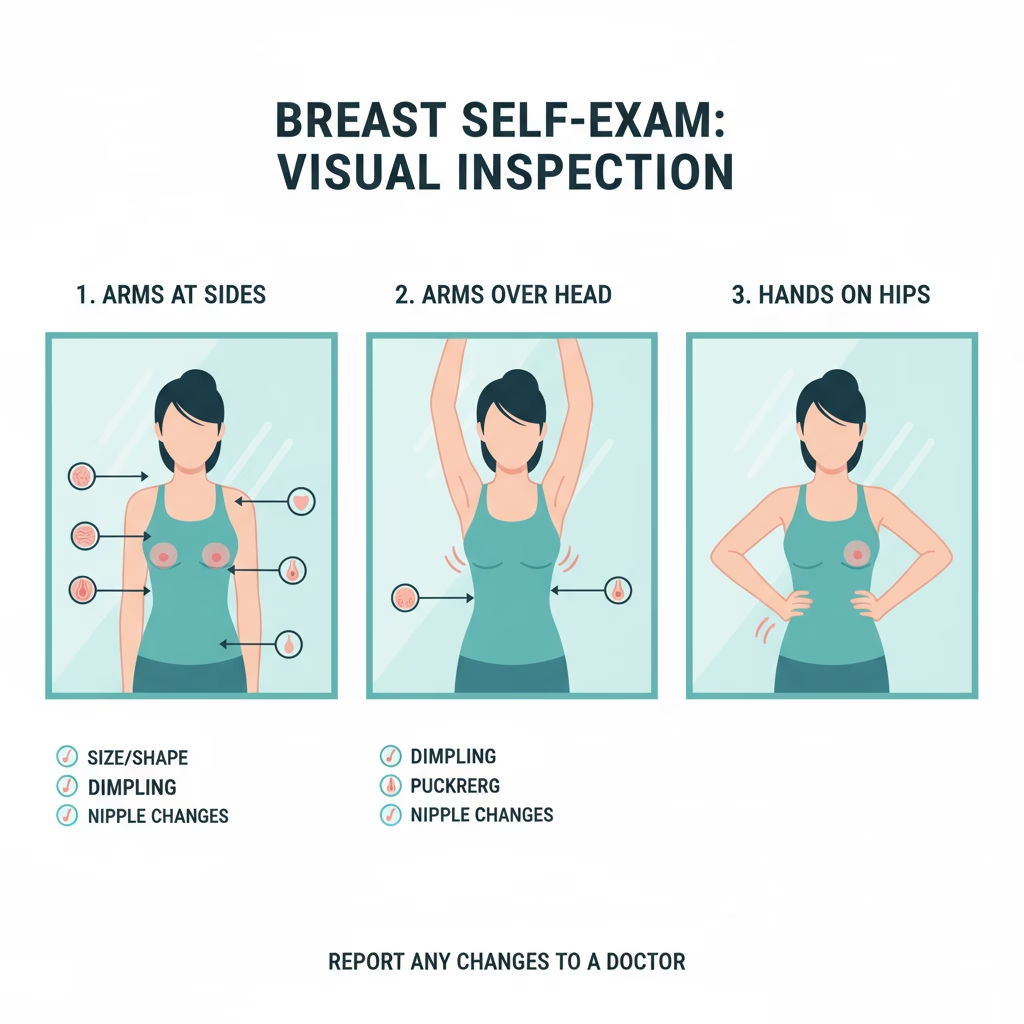
Step 2: The Physical Check (In the Shower or Lying Down)
-
Use the pads of your three middle fingers—not the tips.
-
Apply light, medium, and firm pressure in a systematic pattern. You can use:
-
The Circular method: Small, dime-sized circles.
-
The Vertical/Horizontal method: Moving up and down in vertical strips.
-
-
Cover the entire breast from collarbone to the top of your abdomen, and from armpit to cleavage.
-
Don’t forget your armpits, as breast tissue extends there.
-
Gently squeeze the nipple to check for discharge.

The Thorough Skin Self-Exam: Don’t Miss a Spot
The Skin Cancer Foundation recommends a full-body exam from head to toe 6. Most people only check obvious areas, but melanoma can hide.
The Systematic Scan:
-
Face, Ears, Neck, and Scalp: Use a comb to part your hair and check your scalp. A blow-dryer on a cool setting can help.
-
Hands: Check front, back, fingernails, and between fingers.
-
Arms: Check all sides, including underarms and elbows.
-
Torso: Chest and abdomen. Women should check under the breasts.
-
Back, Buttocks, and Genital Area: Use the hand mirror for your back and back of thighs.
-
Legs and Feet: Check all sides, including the soles, heels, toenails, and between toes.
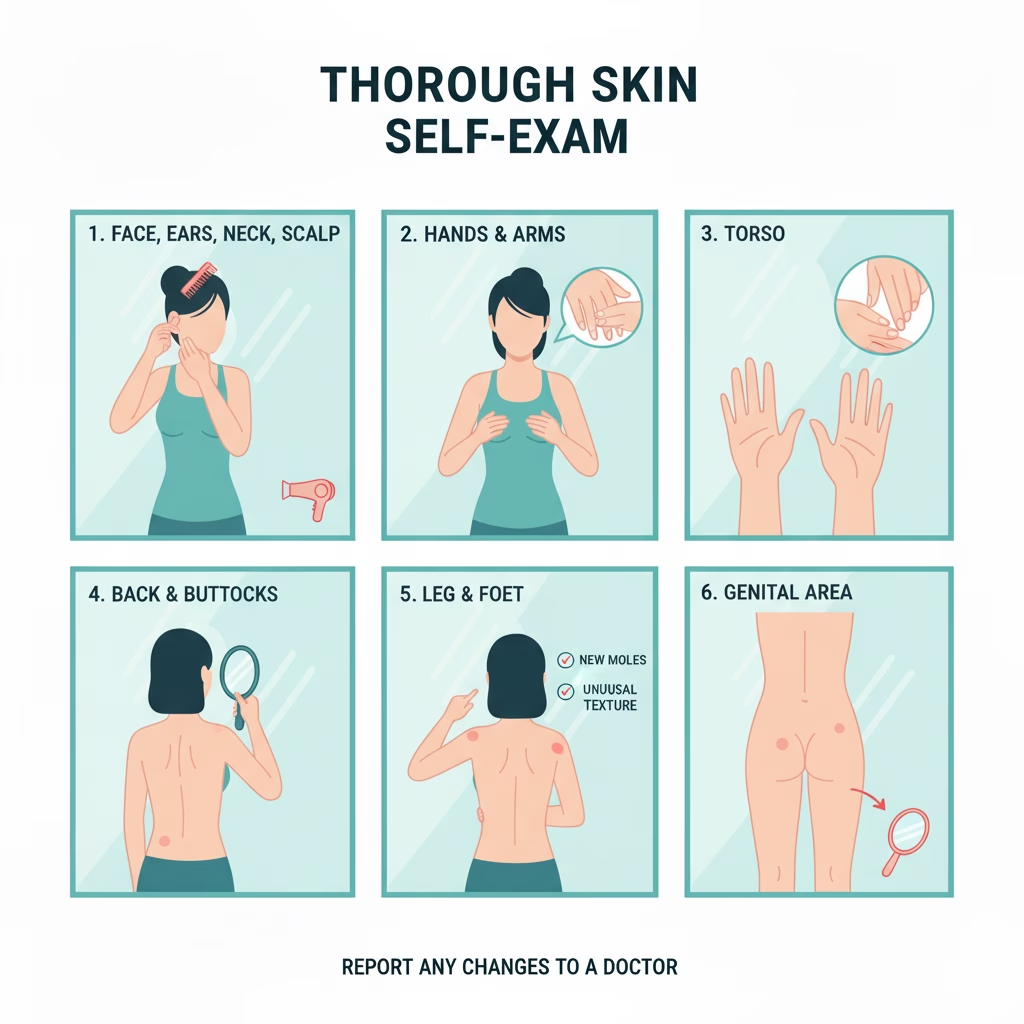
What to Look For: The ABCDEs of Melanoma & The “Ugly Duckling”
-
Asymmetry: One half of the mole doesn’t match the other.
-
Border: Edges are irregular, ragged, or blurred.
-
Color: Color is not uniform and may include shades of brown, black, pink, white, or blue.
-
Diameter: The spot is larger than 6mm (about the size of a pencil eraser), though melanomas can be smaller.
-
Evolving: The mole is changing in size, shape, or color.
-
The “Ugly Duckling” Sign: This is a critical concept many blogs miss. Look for a mole or spot that looks and feels different from all the others on your body 11.
What Most Guides Don’t Tell You: Research-Backed Tips
-
Tracking is Key: Take photos of moles or areas of concern with your phone (including a ruler for scale) and date them. Studies show that digital tracking significantly improves the quality of self-exams 5.
-
Knowledge Alone Isn’t Enough: A 2025 study in PLOS ONE found that women with more BSE knowledge and regular reminders were 5 times more likely to practice it properly. Set a monthly calendar reminder 4.
-
Look Beyond the Lump: For breast exams, be just as concerned with skin thickening, persistent pain, or a new area that feels different, even if it’s not a defined lump.
Common Self-Exam Mistakes to Avoid
-
Rushing: A proper exam takes 10-15 minutes.
-
Skipping “Hard-to-See” Areas: The back, scalp, and soles of the feet are common sites for melanoma.
-
Only Feeling for Lumps: Remember the visual signs for both breast and skin.
-
Not Following Up: Finding something unusual can be scary, but prompt action is crucial. Don’t fall into the “wait-and-see” trap.
When to See a Doctor: The “Red Flag” List
Contact a healthcare provider if you notice any of the following:
-
For Breasts: A new lump, hard knot, or thickening; dimpling, puckering, or scaling of the skin; a nipple that turns inward; nipple discharge; persistent pain in one spot.
-
For Skin: Any new growth; a sore that doesn’t heal; any existing mole that changes in size, shape, color, or begins to bleed or itch.
Remember: Most changes are not cancer, but only a doctor can make that determination.
Frequently Asked Questions
Q: Are self-exams still recommended if I get regular mammograms?
A: Yes. A mammogram is essential, but it’s not 100% foolproof and is done annually. A monthly self-exam helps you monitor changes in the months between screenings.
Q: At what age should I start doing these exams?
A: For breast awareness, it’s good to start in your 20s. For skin exams, it’s never too early to start building the habit, especially if you have a family history or fair skin.
Q: I found something. How long should I wait to see a doctor?
A: Don’t wait. Schedule an appointment as soon as possible, ideally within a few weeks. Early evaluation provides peace of mind and allows for the earliest possible intervention if needed.
10. Conclusion: Empowerment Through Awareness
Taking a few minutes each month to check your body is a powerful act of self-care. It puts you in the driver’s seat of your health. By following this modern, evidence-based guide, you’re not just looking for cancer—you’re getting to know the unique map of your body, which is the first and most important step in noticing when something is off.
Your health is in your hands. Be vigilant, be consistent, and always follow up.
Resources & Further Reading

Waqas Khan is a dedicated writer and blogger who has been crafting compelling content since 2012. Specializing in science and technology topics, he has built a reputation for translating complex technical concepts into reader-friendly articles. His work demonstrates a deep understanding of emerging technologies and scientific advancements, making him a reliable voice in the digital content space.

